
‹
›
‹
›
Soil Hydrometer
1. Overview of Soil Hydrometer
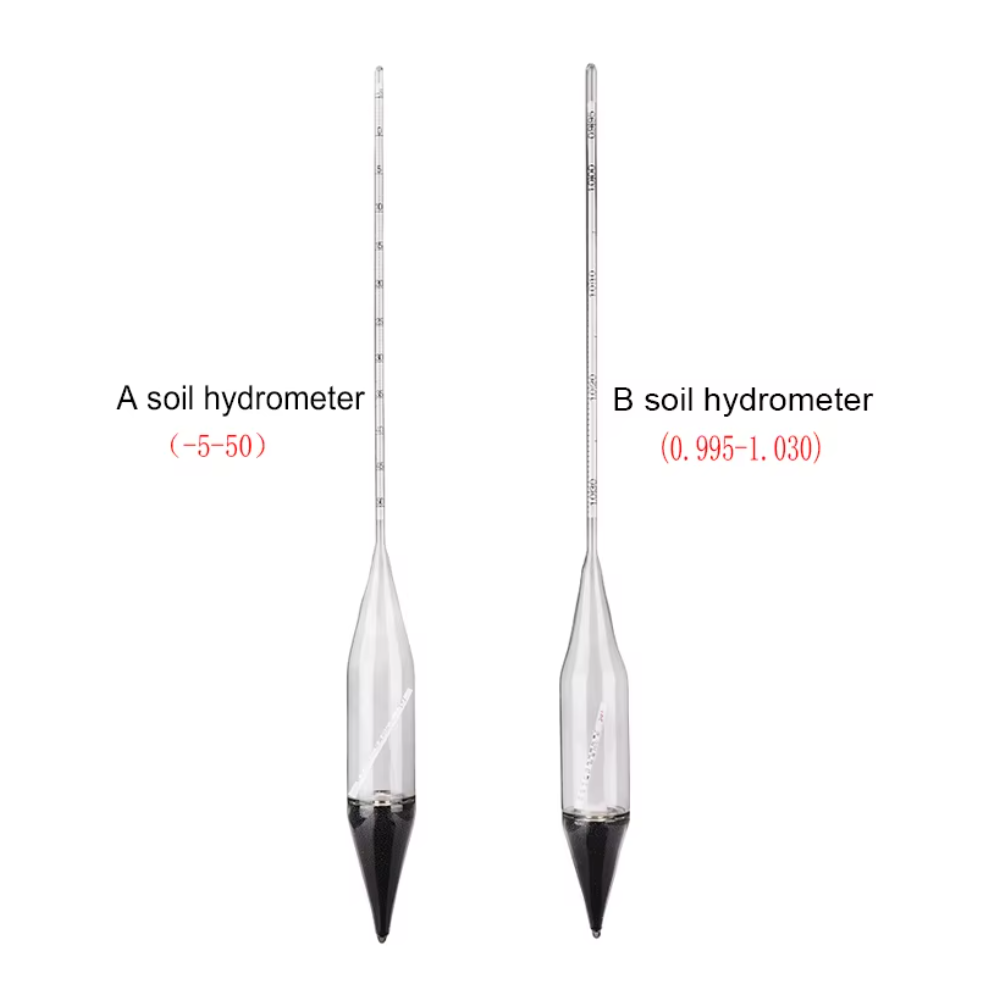
A soil hydrometer, also known as a soil densimeter, is a specialized laboratory glass hydrometer. It is used for particle size analysis of fine-grained soils with particle diameters less than 0.075 mm. By measuring the density change of soil suspension, the content of clay and silt particles as well as soil texture can be calculated.
Two commonly used types (calibrated at 20℃):
①Type A (mass hydrometer): Scale range: -5~50 g/L; minimum division: 0.5 g/L. It directly indicates the mass of soil particles per liter of suspension.
②Type B (specific gravity hydrometer): Scale range: 0.995~1.020; minimum division: 0.0002. It measures the specific gravity of the suspension.
2. Working Principle (Stokes' Law & Buoyancy Equilibrium)
①Settling rule: Soil particles settle freely in water. Larger particles settle faster. At a constant temperature, the settling velocity v is proportional to the square of particle radius r ((v propto r^2)).
②Buoyancy equilibrium: The buoyant force acting on the hydrometer bulb equals its self-weight. A denser suspension with more fine particles makes the hydrometer float higher, resulting in a larger reading.
③Timed reading: After thorough mixing, take readings at 0.5 min, 1 min, 2 min, 5 min, 15 min, 30 min, 60 min, 120 min and 1440 min. Combined with settling time and depth, the percentage of particles finer than a certain size can be calculated.
3. Instruments and Reagents
①Hydrometer: Type A or Type B (with calibration certificate)
②Settling cylinder: 1000 mL, inner diameter 60 mm, height 350 mm
③Auxiliary tools: Stirrer, thermometer (0~50℃, precision 0.1℃), 0.075 mm sieve, mortar, stopwatch
④Dispersant: 4% sodium hexametaphosphate solution (commonly used) to prevent soil particle agglomeration
4. Standard Operating Procedures (GB/T 50123-2019)
①Soil sample preparation: Take 100~300 g of air-dried soil, grind and sieve through a 2 mm sieve. Weigh approximately 30 g of the sieved soil (oven-dry basis).
②Soaking and boiling: Transfer the soil sample into an Erlenmeyer flask, add 200 mL of pure water and soak for no less than 18 hours. Boil the mixture: 1 hour for clay soil, and no less than 0.5 hours for other soils to fully disperse particles.
③Volume fixation and dispersion: After cooling, filter the mixture through a 0.075 mm sieve into a 1000 mL settling cylinder. Add 10 mL of 4% sodium hexametaphosphate solution, then add pure water to make the volume up to 1000 mL.
④Stirring and timing: Stir the suspension up and down for 1 minute without splashing, and start timing immediately after stirring stops. Place the hydrometer gently into the cylinder 15 seconds before reading to avoid hitting the cylinder wall.
⑤Reading and recording: Read the value at the upper meniscus and record the suspension temperature simultaneously. Take out the hydrometer and rinse it with clean water immediately after each reading for later use.
⑥Correction and calculation: Conduct temperature correction, dispersant correction and settling depth correction. Calculate the percentage of each particle group and determine the soil texture.
5. Mandatory Corrections
①Temperature correction: The hydrometer is calibrated at 20℃.
③Settling depth correction:(L = a - bR)Where: (a=21.50), (b=0.27), R = hydrometer reading
6. Common Problems and Notes
①Inaccurate readings: Read the upper meniscus; keep the hydrometer vertical and away from the cylinder wall; place the hydrometer gently 15 seconds in advance to reduce suspension disturbance.
②Particle agglomeration during settling: Use sufficient dispersant and ensure adequate boiling. Add hydrogen peroxide to remove organic matter if the soil contains high organic content.
③Temperature fluctuation: Keep the suspension temperature within (20pm1℃), or carry out strict temperature correction.
7. Application Scenarios
①Geotechnical investigation: Classification of fine-grained soils, evaluation of plasticity and permeability.
②Agricultural soil testing: Determination of soil texture (sand, loam, clay) to guide fertilization and irrigation.
③Environmental monitoring: Particle size analysis of sediments to assess the migration risk of pollutants.
If you are interested in our products, please fill in the message below to contact us and get a quote!
We will get back to you as soon as possible!
Type What You are Looking for